
The crumbling old footpath on the Prussian Trail (poster photo). | Photo: admin.
The Jizera Mountains hide one of the most charming and valuable natural treasures in their heart. An equally rare trail leads to the mysterious world of peat bogs.
The route chosen for a small expedition to the center of the Jizera Mountains will surprise you in many ways. Pruská cesta is very old, with a history dating back several centuries. It was once used by pedestrians and carts, was an important trade route, and was even used for military purposes.
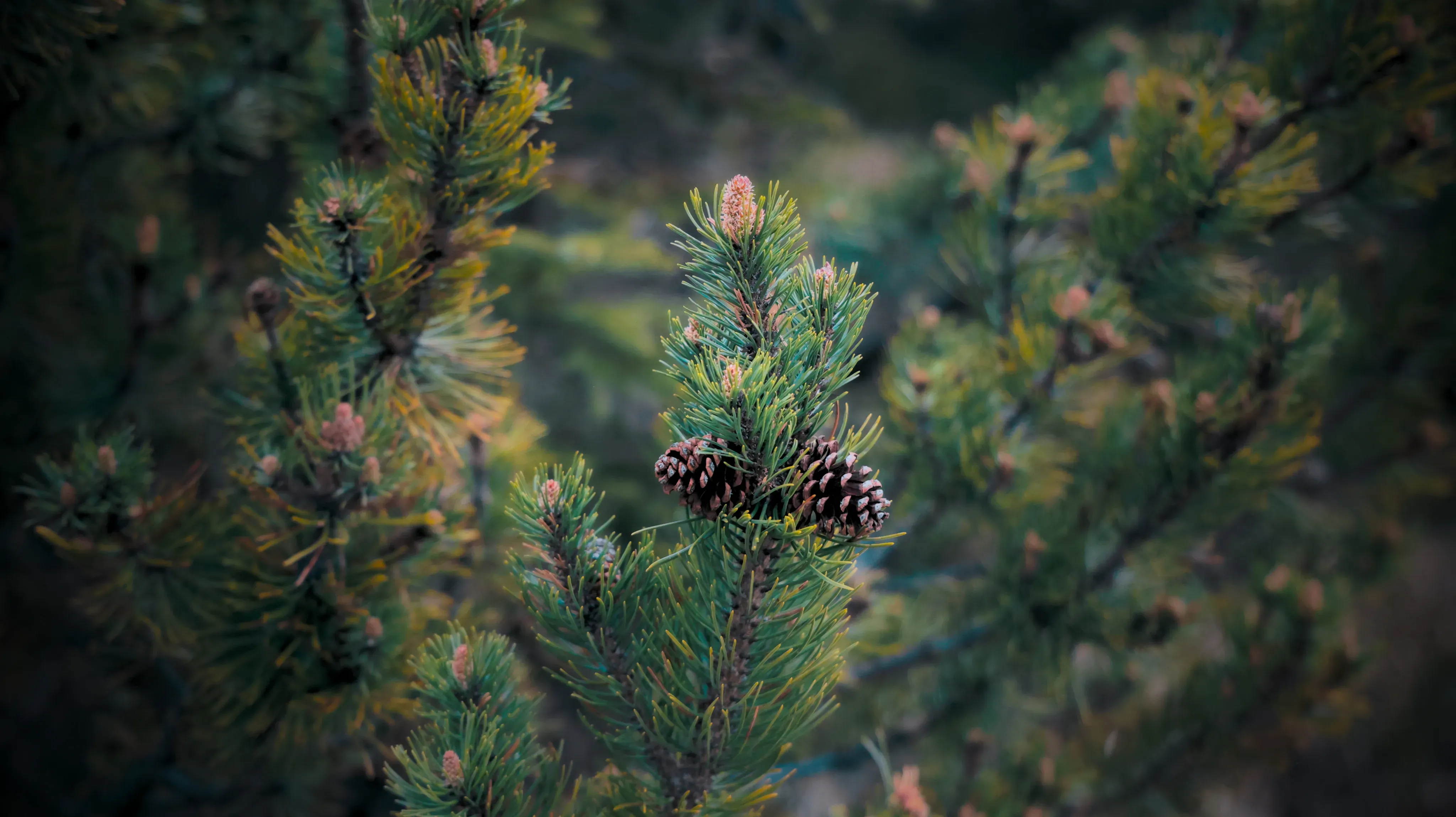
Mountain pine along the road. | Photo: admin.
Today, it is located away from the main tourist routes and is sought after by connoisseurs who appreciate the peace and quiet, the absence of electric bike riders, the mysterious and unusual atmosphere, and the wild nature around the protected peat bogs, spruce forests, and mountain meadows in the Černá jezírka Nature Reserve.
Near the lakes themselves, the landscape changes into a highly valued and unique complex of wetlands, pools, and lakes with typical mountain vegetation.
The more educated, better, and nobler a person is, the more they appreciate nature
Jan Amos Komenský (John Amos Comenius)
The trail also leads partly through the nature reserve and after a few hundred meters it disappears into the surrounding terrain. This process of spontaneous disappearance of trails means that over time the entire area will become an impassable nature reserve.
Route
(1.) It starts at the Smědava car park, from where you continue on foot along Jizerská Road (there is very little traffic on the road) to the turn-off (2.) onto Pruská Road. After a few meters, you will notice that you are on a path that differs from the main road (wet soil, dense spruce stands, mountain pine, gray tree stumps, etc.). At point 3., turn left (before Pruská cesta merges with the forest) onto a historically old and straight path around the nature reserve.
About halfway through, you will cross Krásný potok. It is usually relatively swollen, and the terrain around the stream is heavily waterlogged. So remember to wear suitable footwear and tread carefully on raised, solid clumps of vegetation (if possible) when crossing.

The surroundings of Krásný potok at the crossing point. | Photo: admin.
A small warning. Although Krásný Creek is not in the reserve at the crossing point, you may not find a suitable place to cross and will have to turn back.
When you reach the classic crossroads of two paths, turn left to the memorial site (4.). Continuing on, you will come to another classic crossroads (5. Signpost). There should be a small boundary stone there. From here, I recommend returning via point 6. Černá Smědá crossroads. You can continue to it in various ways. Turn left (and then right twice), along the nature reserve, where the path is difficult to see after a few meters. The easiest way is to continue along the path on the right.
Length of the route: 6 to 7 km (depending on the return route)
Time: a leisurely 2 to 3 hours
Memorial to Karel Nádeník
At point 4, you will pass a memorial site where a teacher from Nové Město pod Smrkem, a great expert and admirer of the Jizera Mountains, photographer, contributor to magazines and publications about the Jizera Mountains, and main author of the book Smrk - král Jizerských hor (Smrk - King of the Jizera Mountains) suddenly passed away.
You may now be wondering about the five lakes marked on the map. According to local experts, two of them are full of water, one is overgrown with vegetation, and the remaining two have almost no water. One even mysteriously drains away in a small stream, as if some mischievous person had diverted it.
Černá jezírka Nature Reserve
It is located at an altitude of 885–912 meters above sea level on an area of 66.6 hectares with an additional 72.4 hectares of protected zone. It is an internationally important wetland area. The reason for its protection is not only the peat bogs, which are extremely sensitive to human influence, but also the remnants of climax mountain spruce forests.

Black Lake in the Jizera Mountains. | Photo: Elingr Zbyněk, CC-BY-SA-3.0, https://commons.wikimedia.org
Unique flora and fauna
There are several species of moss in the upland area that absorb water extremely well and have no roots. They constantly die off from the bottom and grow from the top (the principle of peat bog formation). Here you will find, for example, the quite conspicuous Eriophorum vaginatum, Scheuchzeria palustris, several species of sedges (including the rare Carex limosa) and also carnivorous plants (Drosera rotundifolia).
It is no coincidence that it neighbors the Tetřeví louka nature reserve. The hazel grouse is a close relative of capercaillies and pheasants and is known for its conspicuous courtship (calling). You will also see the common redpoll, meadow pipit, red crossbill, etc. A white wagtail kept me company for about 10 minutes. That was very surprising.
In winter, I saw lone wolf tracks in the snow here.
Why not enter the peat bogs
It is not just about protecting the nature of the Jizera Mountains, which dates back to the Ice Age. Peat bogs (also known as moors or marshes) also pose hidden dangers. In places, they are over four meters deep (which indicates the great age and stability of the ecosystem), and you may not be able to get out of them (they are essentially a swamp ecosystem). Therefore, it is only safe to walk on raised hills or tufts of sedges, etc. Avoid waterlogged and unfamiliar areas, and only walk on trails that are marked on maps or have been tested. Ultimately, you should not walk off the trails in a nature reserve.
-
short video from a small expedition (with unexpected weather changes and snowfall)

Conclusion
Černá jezírka (Black Lakes) are an irreplaceable natural treasure of a fragile ecosystem that has survived in the Jizera Mountains for thousands and thousands of years. People should only observe it from a distance (with the exception of boardwalks) and leave no (harmful) traces behind when passing through in large numbers. Therefore, the route does not lead directly to the lakes, but only around them through beautiful nature. It is more suitable for individuals, couples, or small groups, not for tour groups. Only in this way will the thousand-year-old life story of these unique lakes continue.
Weather forecast for the trip area
The lake area is right in the middle of the map.
The trail has several risks. In some places, it disappears or you are walking more on a footpath. It does not lead directly to the lakes. They are in a nature reserve. You may encounter waterlogged terrain and the swollen Krásný potok stream, which may prevent you from completing the trail. It depends on the season.
Therefore, it is essential to wear good shoes, not to go alone, and to have a mobile phone (however, there is no signal in some places). The route is not suitable for hiking, so you will hardly meet anyone here. The trail is relatively easy to walk in dry summer if you follow the map. However, keep in mind that it leads around a nature reserve with peat bogs (swamps) and lakes 2 to 4 meters deep. If you get stuck, it will be difficult to help you.