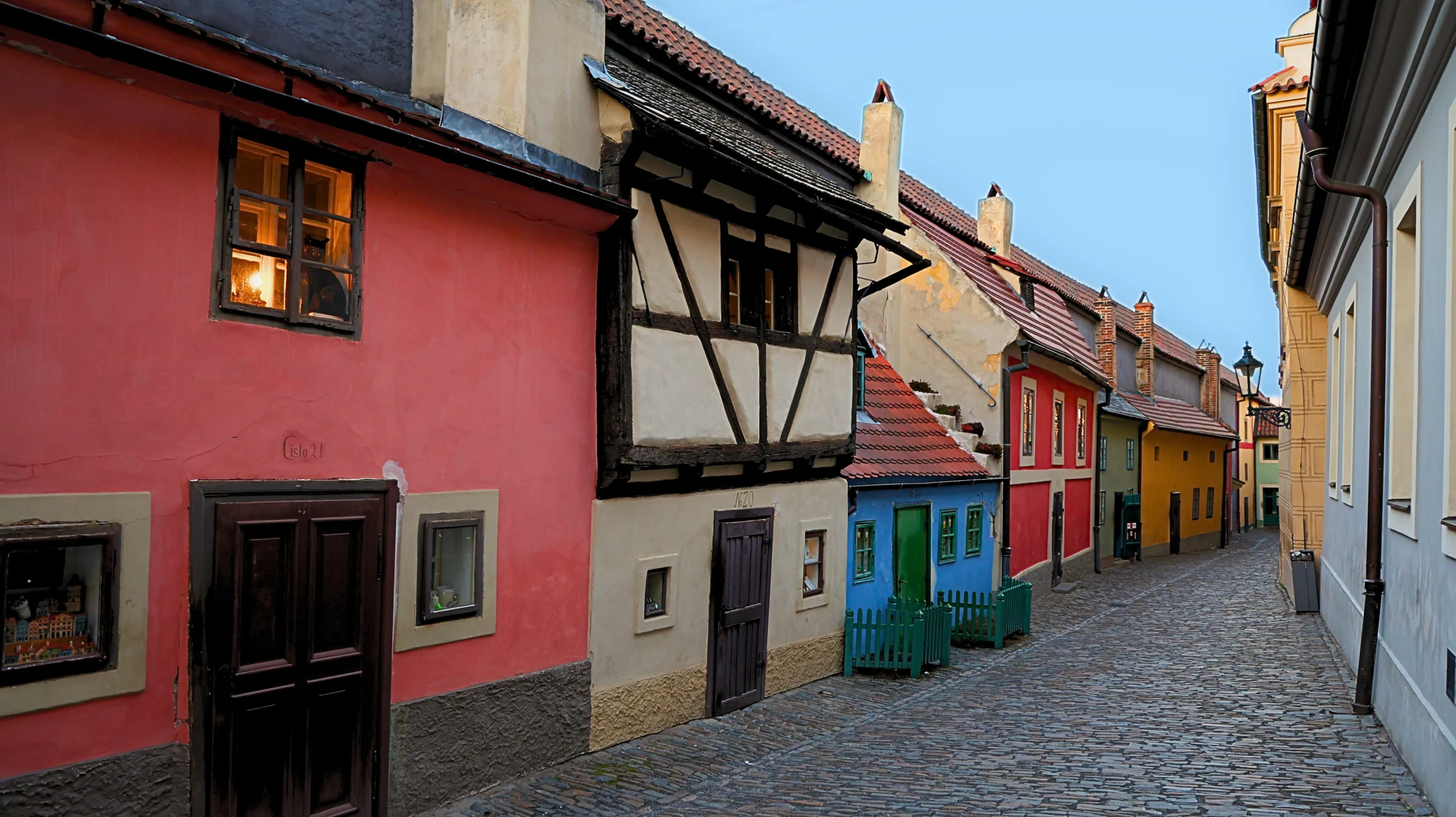
Golden Lane from house No. 21 to house No. 12. | Photo: admin.
How to get around the entrance fee to Prague’s historic Golden Lane, enjoy the best atmosphere, and what you’ll have to give up in return.
The full and proper name is Golden Lane by Daliborka. It’s useful to use the complete name if you want to avoid confusion with other streets of the same name in the Czech Republic. So, how do you get there?
Route
Tourists usually walk to the Golden Lane only when visiting Prague Castle (or during a castle tour). Most commonly via Nerudova Street, the castle stairs, from Pohořelec, or after a visit to the Petřín Lookout Tower. The more informed ones try to avoid the crowds and arrive, for example, from Prašný most. But during tourist season, it doesn’t help much.
There are several possible routes, and we will show one lesser-known path starting from the Vltavská metro station.
It’s only 4 kilometers long, but for sensitive and observant souls, the walk offers so many beautiful sights and views that an hour won’t be enough. Expect it to take 2 to 3 hours. At the moment the advantage is that the trees in Letenské sady will not have leaves obstructing the view for a few days.
Route Description:
1. Start – Vltavská | 2. Strossmayer Square with the Church of St. Anthony of Padua | 3. Expo 58 Pavilion | 4. Letná Viewpoint | 5. Pendulum Viewpoint in Letná Park (former site of the Stalin Monument, 1955–1962) | 6. Scenic View | 7. Water Reservoir | 8. Hanavský Pavilion | 9. Pedestrian Bridge | 10. Scenic View | 11. Queen Anne’s Summer Palace (Belvedere) | 12. Former Powder Bridge over the Deer Moat (now an embankment) | 13. St. Vitus, St. Wenceslas and St. Adalbert Cathedral | 14. Golden Lane – Final destination
Between points 11 and 12, the path leads through the Castle grounds, past the Orangery, the Great Ball Game Hall, the accessible Royal Garden, and the lower part of the Deer Moat. However, access to the area is extended only during the tourist season starting in April. Since your goal is to reach the Golden Lane in the early evening (around 6–7 PM), you must pass this section earlier (until March, it’s only open until 5 PM) or go around via Mariánské hradby street.

A historic tram line no. 42 on Mariánské hradby street. | Photo: admin.
This detour will add about 250 meters to your journey and leads (unfortunately) along a busy road. But you might get lucky and see a historic tram pass by.
What attracts tourists to the Golden Lane
Cobblestone paving with fairy-tale-like, tiny, low, and colorful houses with chimneys and small windows built into the castle wall that once connected the northern fortification (White Tower) with the old Burgrave’s House (Daliborka).
Although the houses date back to the 16th century (1597), they were inhabited until the start of World War II. However, these are not the original buildings. Before them, there were very poor (semi-open) shelters for the destitute residents of Hradčany.
The colorful appearance of the houses was suggested by Jiří Trnka in 1955, after the Presidential Office bought the houses from their owners in 1953. Most of the time, though, their colors are faded; only after restoration do they appear more vivid and bright.
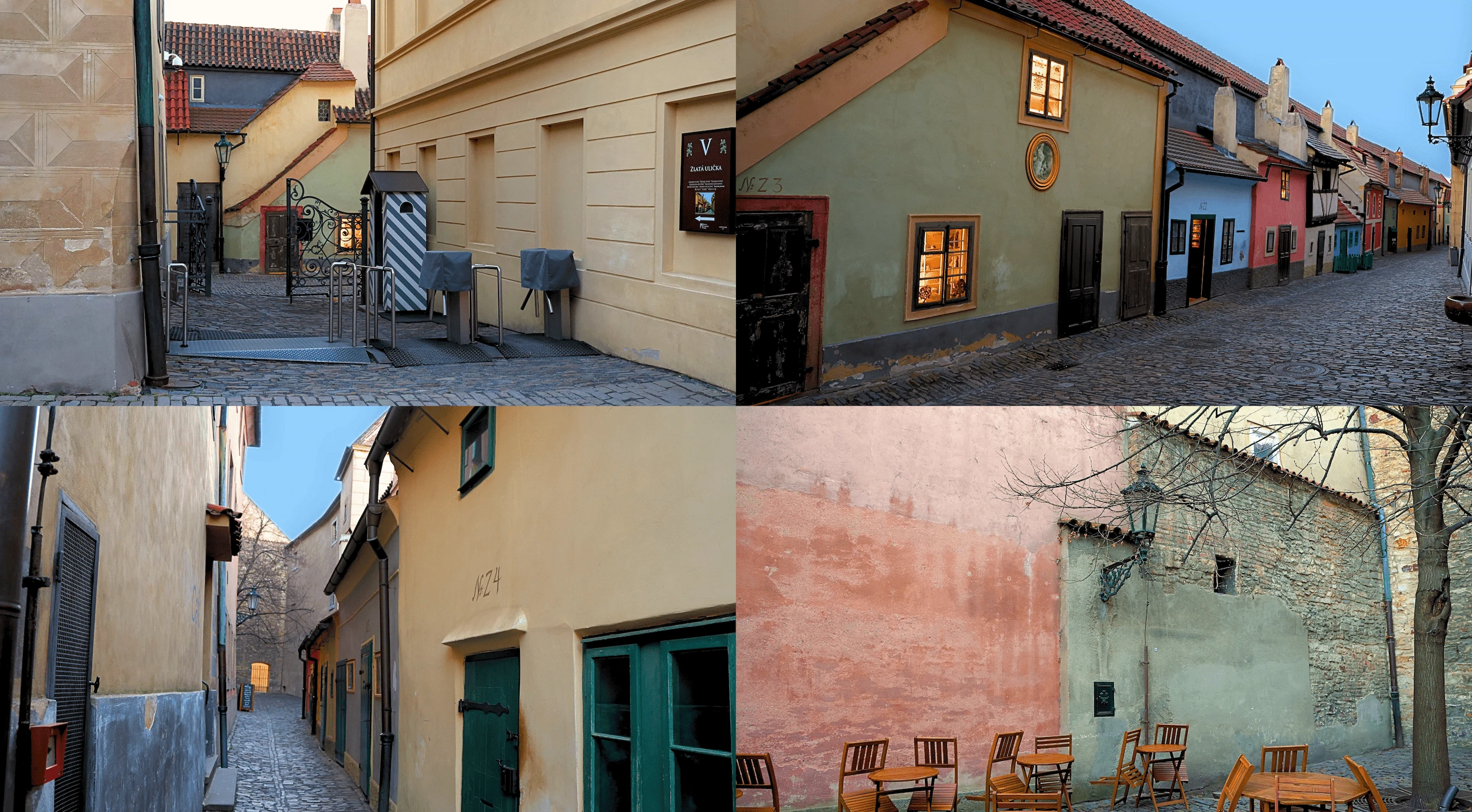
1. Paid entrance to the Golden Lane through turnstiles. | 2. Initial view of Golden Lane. Some tourists immediately turn right and head for the exit. | 3. They miss the narrower left section of the lane. | 4. Enjoying a coffee under a tree’s shade and tall surrounding walls is a real delight on hot summer days. | Photo: admin.
Originally, the lane was known simply as “Zlatnická” (Goldsmith Lane). Possibly mockingly, due to its poverty. Or because goldsmiths or palace guards with golden insignia lived here, or perhaps alchemists trying to create gold. None of these have been confirmed.
What is known is that the solid structure of the houses began when guards at the castle gates, with Emperor Rudolf II's approval, built tiny chambers into the wall niches. Later, they expanded these into small houses, sold or rented them, and even built houses on the opposite Romanesque wall and the wall of the Burgrave’s House. At some points, the lane was so narrow at some points, it was barely walkable. In 1894, all extensions and sheds were demolished, and it remains that way today.
Magical atmosphere
The lane is famous for being a brief home (Nov 1916 – Mar 1917) to Franz Kafka, who lived in the blue house No. 22 thanks to his sister Ottla, who rented it. A simple plaque reads:
Franz Kafka lived here.
In the green house No. 12 at the end of the lane, writers like Jaroslav Seifert (who also lived in an adjacent house no longer standing), Vítězslav Nezval, and František Halas would gather, along with Jiří Mařánek, Otakar Štorch-Marien, and others.
The lane also appears in the mystical novel “By the Last Lantern” by Gustav Meyrink.
In the blue-green house No. 14 lived the famous clairvoyant and card reader (and also embroiderer) Matylda Průšová, known as Madame de Thébes. She was tortured to death by the Gestapo in late 1944. She had predicted the fall of the Third Reich.

A shop sign featuring an owl, cat, playing cards, and a crystal ball on house No. 14 – the home of Madame de Thébes. | Photo: admin.
There are 24 structures in the lane, 16 of which are colorful little houses (including the smallest house in Prague at the end).
The lane has long been surrounded by myths and legends. One tale speaks of a mysterious professor who who consorted with the devil and met his end in hell, like Doctor Faustus.
As early as the second half of the 19th century, someone realized the lane might be attractive to tourists…

1. Occasionally overlooked part of the Golden Lane near the bistro (by the White Tower). | 2. The lane including the opposite side. | 3. View of the first (green) house upon entering the lane. | 4. A little house with a front garden, where flowers bloom in the warmer months. | Photo: admin.
Today, the magical atmosphere of the Golden Lane is almost lost. And yet, there is a time (especially on weekdays) when you can find yourself alone in the lane, even during peak tourist season, feeling the cool silence of the old castle walls, hearing only the chime of tower clocks. And if you close your eyes for a moment, you may find yourself transported into a magical past.
The best time begins at the start of civil twilight. That’s when you should be nearby. As nautical twilight approaches, the number of visitors rapidly declines, dusk falls, and the first lanterns begin to glow. As long as no one asks you to leave, you can enjoy the soft light from the lanterns and the glowing windows of the little houses until astronomical twilight. And perhaps, if you're lucky, the mythical house will appear in place of the dark wall between houses No. 13 and 14: an entrance to a parallel Prague.
Free, but...
After 4 PM (or 5 PM in the high season), the fairly steep entrance fee is no longer required, and tour groups have usually dispersed. Some shops (seven of them) and exhibitions (nine in total) might still be open, but it varies greatly from day to day. Unfortunately, during this time, most exhibitions are already closed. That’s likely the only thing you'll have to forgo. But this is really about the atmosphere of the place, and no exhibition of armor, no matter how impressive, can create that.

1. The Golden Lane from house No. 17 to the last house. | 2. A “window” view from the lane into the “courtyard” in front of the Black Tower. | 3. The last house. | 4. An unusual exit from the lane—down the stairs to the statues near Daliborka. | Photo: admin.
Where to Go After the Golden Lane
Don’t miss the stunning view of Prague from Hradčanské Square, right where the Castle Stairs begin. If you manage to leave the Golden Lane before the end of the golden hour (just before the sun sets) and the weather is on your side, you'll enjoy a beautiful finale to your walk.
A Restless Camera
And finally, two and a half minutes with a moving camera: perhaps it will tempt you to take an early evening walk.

Weather forecast for the trip area
The target Golden Lane is right in the middle of the map.
Apart from a short climb at the beginning of Letná Park (point 2 on the map), the route is mostly flat and suitable for adults, children, and seniors alike.
In the park, weather permitting, you’ll come across cyclists, rollerbladers, skateboarders, and individual visitors exploring Prague. Large guided tour groups of foreign tourists are not common here, even during peak tourist season. However, near Prague Castle (points 11 and 12 on the map), you should expect to encounter them.